Advertisements
Advertisements
प्रश्न
What does he see the gardener doing?
विकल्प
Cutting the trees
Cleaning the garden
Digging the earth with his spade and soiling his clothes
None of the above.
Advertisements
उत्तर
Digging the earth with his spade and soiling his clothes
APPEARS IN
संबंधित प्रश्न
Answer of these question in a short paragraph (about 30 words).
How does he describe the old kind of teachers?
Answer of these question in a short paragraph (about 30 words).
What shows her concern for the environment?
Based on your reading of the story, answer the following question by choosing the correct option:
Harold had defied the laws of heredity by
Imagine a child has been caught stealing in school. In groups of eight play the
roles of
- The child caught stealing
- The child she/he stole from
- The teacher
- The headmaster
- The witnesses
Try to find the reason why the child stole and the possible advice you can give her/him.
Should the child be punished? Or should she/he be counselled?
CHARACTERS
The Bishop : An ordained or appointed member of clergy.
Persome : The sister of the Bishop.
Marie : Their house hold helper.
Convict : A prisoner who has been proved guilty of a felony.
Sergeant of Gendarmes : Policeman
Understanding the tenses:
The tense forms that have been practised and discussed in this chapter, allow
you to show accurately and subtly the time and the relationship of actions and
events with it. We use them in speech and writing.
Understanding and recognising how the tense forms are used.
Can you identity the present tense forms.
|
Simple Present 1. I play tennis |
Present Perfect 1. I have played tennis |
|
Present Continuous 1. I am playing tennis |
|
|
Simple Past 1. I knew about it |
Past Perfect 1. I had known about it |
|
Present Continuous 1. I am reading a book. |
Past Continuous 1. I was reading a book. |
Present Perfect Continuous
Read the following sentences with the present perfect continuous tense
form
1. Mr and Mrs Singh have been living in the same house in the same town
for the last five years.
2. "Have you beenkeepingyourpocketmoneysafely, Rani?"
These sentences illustrate the main use of the Present Perfect Continuous
tense to show that the action started in the past and is still in progress in
the present.
“I love the West,” said the girl irrelevantly. Her eyes were shining softly. She looked away out the car window. She began to speak truly and simply without the gloss of style and manner: “Mamma and I spent the summer in Deliver. She went home a week ago
because father was slightly ill. I could live and be happy in the West. I think the air here agrees with me. Money isn’t everything. But people always misunderstand things and remain stupid—” “Say, Mr. Marshal,” growled the glum-faced man. “This isn’t quite fair. I’m needing a drink, and haven’t had a smoke all day. Haven’t you talked long enough? Take me in the smoker now, won’t you? I’m half dead for a pipe.”
The bound travellers rose to their feet, Easton with the Same slow smile on his face. “I can’t deny a petition for tobacco,” he said, lightly. “It’s the one friend of the unfortunate. Good-bye, Miss Fairchild. Duty calls, you know.” He held out his hand for a farewell. “It’s too bad you are not going East,” she said, reclothing herself with manner and style. “But you must go on to Leavenworth, I suppose?” “Yes,” said Easton, “I must go on to Leavenworth.”
The two men sidled down the aisle into the smoker. The two passengers in a seat near by had heard most of the conversation. Said one of them: “That marshal’s a good sort of chap. Some of these Western fellows are all right.” “Pretty young to hold an office like that, isn’t he?” asked the other. “Young!” exclaimed the first speaker, “why—Oh! didn’t you catch on? Say—did you ever know an officer to handcuff a prisoner to his right hand?”
Read the extract given below and answer the question that follow.
Why is Fairchild heading east?
But even as he approached the boy, Mr. Oliver sensed that something was wrong. The boy appeared to be crying. His head hung down, he held his face in his hands, and his body shook convulsively. It was a strange, soundless weeping, and Mr. Oliver felt distinctly uneasy.
Well, what’s the matter, he asked, his anger giving way to concern. What are you crying for? The boy would not answer or look up. His body continued to be wracked with silent sobbing.
Oh, come on, boy. You shouldn’t be out here at this hour. Tell me the trouble. Look up.
Read the extract given below and answer the question that follow.
When did Mr Oliver sense that there was something wrong?
Ravi has a lot to say about M.P.Poonai. This shows that
Which of these statements do you agree/disagree to?
Why was Tansen afraid of singing Raga Deepak?
Answer the following question:
Why did Taro run in the direction of the stream?
Complete the following sentence.
The banyan tree served the boy as a ________.
Multiple Choice Question:
What does the phrase “repeat themselves’ mean here?
Answer the question.
What do you think these phrases from the poem mean?Punished in the corner.
Multiple Choice Question:
What does the child finally decide?
Look at the following picture. One asks a question, the other answers it. Then the answer is noted in a form as shown below.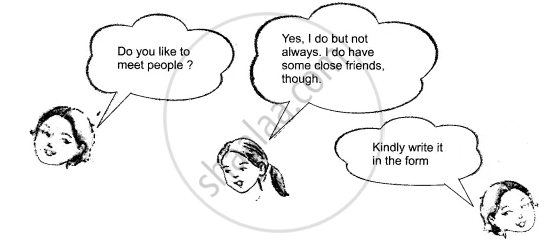
| Questions | Yes/No | Additional Response |
|
1. Do you like to meet people? |
Yes I do, but not always | I do have some close friends, though. |
|
2. Do you like the area you live in? |
No, I Don't | But I have no choice |
The words given against the sentences below can be used both as nouns and verbs. Use them appropriately to fill in the blanks.
(i) The police are _______________________ the area to catch the burglars. (comb)
(ii) An ordinary plastic ______________________________ costs five rupees.
What is ‘strange’ about Mr Nath’s Sundays?
Read the extract given below and answer the questions that follow:
| An angry athlete is an athlete who will make mistakes, as any coach will tell you. I was no exception. On the first of my three qualifying jumps, I leaped from several inches beyond the take-off board for a foul. |
- When and where is this narrative set? [2]
- What reason does the narrator Jesse Owens give for the heightened nationalistic feelings at this time? [2]
- In which event had Owens been confident of winning a gold medal? Why? [3]
- What had made Owens angry enough to make mistakes? Name Owens’ rival who approached him at this point. [3]
Complete the following sentence by providing a reason:
In the poem, Dover Beach, the poet wants his beloved to be "true" to him because ______.