Advertisements
Advertisements
Question
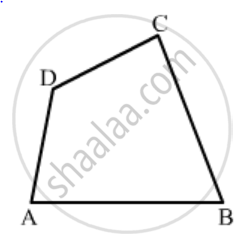
In Fig. 16.19, ABCD is a quadrilateral.
How many pairs of adjacent angles are there?
Advertisements
Solution
Four
APPEARS IN
RELATED QUESTIONS
Complete of the following, so as to make a true statement:
The number of pairs of opposite angles of a quadrilateral is .......
Complete of the following, so as to make a true statement:
A quadrilateral is convex if, for each side, the remaining ______ lie on the same side of the line containing the side.
If the bisectors of two adjacent angles A and B of a quadrilateral ABCD intersect at a point O such that ∠C + ∠D = k ∠AOB, then find the value of k.
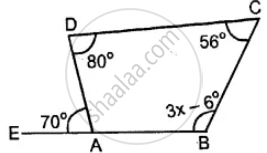
Use the information given in the following figure to find the value of x.
If three angles of a quadrilateral are 90° each, show that the given quadrilateral is a rectangle.
The diagonals of a rhombus are 6 .cm and 8 cm. State the angle at which these diagonals intersect.
If one angle of a cyclic quadrilateral is 75°, then the opposite angle is
If APB and CQD are two parallel lines, then the bisectors of the angles APQ, BPQ, CQP and PQD form ______.
What is the maximum number of obtuse angles that a quadrilateral can have?
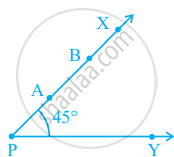
In the following figure, if point A is shifted to point B along the ray PX such that PB = 2PA, then the measure of ∠BPY is ______.