Advertisements
Advertisements
Question
‘Live as if you were to die tomorrow. Learn as if you were to live forever.’ Mahatma Gandhi
Collect some more quotes on education by famous thinkers.
Advertisements
Solution
‘Live as if you were to die tomorrow. Learn as if you were to live forever.’ – Mahatma Gandhi
Through this quote, Mahatma Gandhi states the importance of learning and the need to look at it as an infinite process. By saying, 'live like you are going to die tomorrow', he gives the message of living every moment of life to the fullest and utilizing your present for productive deeds without delaying it, as the future is unpredictable. Further in the quote, he says 'learn as if you will live forever'. This part of the quote urges us to continue learning new things, thoughts, and perspectives throughout our lives.
Some more quotes on education by famous thinkers are:
- Education is the ability to listen to almost anything without losing your temper or self-confidence - Robert Frost.
- The whole purpose of education is to turn mirrors into windows - Sydney J. Harris.
- Curiosity is the wick in the candle of learning - William Arthur Ward.
- No thief, however skillful, can rob one of knowledge, and that is why knowledge is the best and safest treasure to acquire - L. Frank Baum.
APPEARS IN
RELATED QUESTIONS
Suggest two measures to increase the number of birds.
Arun was asked by his mother to explain the missing buttons on his shirt.
(Rewrite: Using ‘explanation’)
Do you agree with his justification of the war? Why/ why not?
Define the following terms from the poem: rivulet, plough share (plowshare), yon, and childing.
How is the last verse different from the other verse? Is the poet deriving a different mood than that expressed in the previous verse?
Explain the phrase ‘bliss of solitude’ in the context in which it has been used.
Write a short note on Abou bin Adhem.
Besides being an amusing tale about a failure to communicate the story “A Horse and Two Goats” makes some crucial points also. Justify.
Discuss theme of kindness and compassion in “Hearts and Hands” by O. Henry?
The author shows death as a relief from a harsh life. Justify with reference to the story.
The Little Match Girl can be viewed as a work of opposites. Justify.
This is the place. The dog was rescued from its cruel owner.
Write a composition (350 - 400 words) on the following:
Narrate an incident from your own experience when you expected to do very well, but for some reason were unable to do so. Explain what happened and why it happened. What lesson did you learn from it?
Fill in each of the numbered blanks with the correct form of the word given in brackets. Do not copy the passage, but write in correct serial order the word or phrase appropriate to the blank space.
Example:
(0) He had been (0) ……… (sit) on the bank of a small irrigation canal.
Answer: sitting
He was (1) ………. (gaze) at a couple of herons (2) ……… (fish) in the muddy water, when he (3) ……… (feel) something bumps his elbow. (4) ……… (look) around, he (5) ………. (find) at his side a little goat, jet black and soft as velvet with lovely grey eyes. Neither her owner nor her mother (6) ……… (be) around. She continued to (7) ……… (nudge) Mukesh, so he (8) ……… (look) in his pocket for nourishment.
Discuss how the speaker in the poem Do Not Go Gentle Into That Good Night rages against the traditional acceptance of death.
Re-write the following sentence according to the instructions are given. Make other changes that may be necessary, but do not change the meaning of the sentence.
The monsoon is the best season in our country.
(Rewrite using ‘good’)
"Boxer lives his life in patience and unquestioning service." How far is this statement true? Throw light on Boxer's character.
In what ways do you think we could help prevent the extinction of languages and dialects?
The sound words
Other sounds that occur frequently in the poem.
Discuss in pairs or in small groups
The Indian family system offers more security to the aged than what is found in the West.
Multiple Choice Question:
The poet had a quarrel with her ______
In her message to students of her college, Kalpana Chawla said, “May you have the vision to find the path from dreams to success … Wishing you a great journey.”
Form pairs. Use “May you…” and “I wish you/Wishing you” to wish your partner good luck and success in
- a sports event,
- a quiz or a competition, and
- a test or examination.
Be sure to thank your partner when she/he wishes you in turn. You may also look up a telephone directory, or go to a post office, and get a list in English and Hindi of standard phrases that can be sent in greeting telegrams anywhere in India. Discuss which of these you might use, and when. Compare the English and Hindi phrases for expressing good wishes. Do you know such phrases in any other language?
What do you know about Kalpana Chawla’s birth, education, a great achievement, and tragic end?
The word ‘round’ usually means a kind of shape. What is its meaning in the story?
The words in the box are all words that describe movement. Use them to fill in the blank in the sentence below.
When he began to trust me, the squirrel began ____________ into my pockets for morsels of cake.
Describe in about 150 words your experience similar to the writer’s when you pursued something and reached your goal.
The poem describes the beauty of Nature. Make a list of careers that are related to Nature, the environment, and the forest. One is done for you.
- Forest Department - (Forest officer, Ranger, etc.)
- .....................................
- .....................................
- .....................................
- .....................................
Find out the words and phrases which describe the following. One is done for you.
| sight | touching in its majesty |
| air | |
| river | |
| house | |
| morning | |
| sun |
“Lend thy ears to all but few thy tongue”…. is a famous quote by William Shakespeare. Justify.
Guess the meaning of the above proverbs and write them down along with a sentence of your own.
Given below is a list of words used to develop a CV or a Resume. Prepare a CV/Resume of your own.
Personal Information
- Name
- Address
- Date of birth
- Telephone / E-mail
- Nationality
- Marital status
Work Experience
- Experience/ Occupation / Position
- Employer / Employment History
- Internships
- Activities and responsibilities
Education
- Education and Training
- Primary school
- Secondary school
- Other qualification
Personal Skills and Competencies
- Competencies / Personal Competencies / Personal Skills/ Computer skills Mother tongue/ Other languages / Foreign languages
Visit a library. Find a school poem. Recite it to your parents.
Note down ways in which you can make your life less ordinary in terms of nurturing relationships.
Form pairs. Discuss how ‘Part II’ of the story could have been different. Write your storyline in the form of bullets showing the main events.
Write the rhyme scheme of the poem (Invictus).
Now read the beginning and end of a sci-fi story given below and complete the story using your imagination.
|
‘The Magic Glasses’ After ten years of diligent experimenting on ‘light’, Jayant, a brilliant scientist, created a pair of eye-glasses which would enable him to see through all opaque objects, doors, walls, metal structures, etc. On Monday, he put on his ‘magic’ glasses and stepped into the busy street outside ____________________________ ______________________________________________________ ______________________________________________________ ______________________________________________________ ______________________________________________________ And so, Jayant received the ‘State Award for Brave Citizens’ _____________________________________________ |
Write 3 to 5 sentences about the following character.
The Aunt
Study the following format of an informal letter carefully. Using the format,
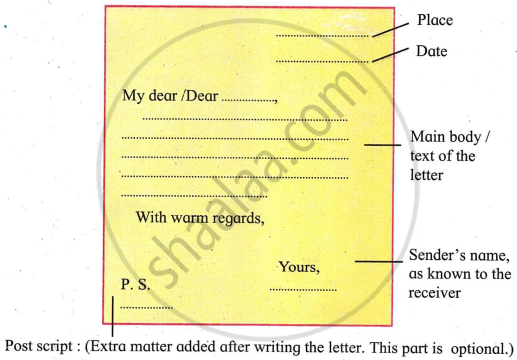
Write an informal letter to your friend who has gone to another town for a month.
When a family member is very ill for long, the grandmother of the family urges everyone to send for a person who claims he can cure victims of black magic. Compose a dialogue with her, in which her granddaughter politely convinces her that she should not believe in such things.
Speech development
Explain the following points to develop speech.
- Content
- Speaking Presentation
- Useful phrases and vocabulary
Divide the class in four groups. Collect four different stories written by Sudha Murthy. Select a story for every group and write it in the form of a play. Enact it in front of the class.
What is the name of her diary?
Look at the image of the familiar advertisement given below. Identify the product and try to frame your own slogan for them.

Create a pamphlet for the following.
Make a pamphlet on the latest gadgets (Mention the variety of models, uses, needs, and availability).
Your friend has presented a beautiful art piece on your birthday. Write a letter to her appreciating her art work.
Develop the following hints.
Tortoise - hare - forest - tortoise walking- seen by a hardware laughs - tortoise speed - tortoise sad - bet - race - tortoise moving- slow speed -hare moves - fast - sleepy tortoise - reaches a winning point - first - wins the bet.
Narrate an incident when you have experienced happiness, excitement, surprise. You can use the following clues.
With whom...
When did it happen...
Why...
Where...
What used to be there in the place of that shop twenty years ago?
What does each of the following mean in the story? Choose the right option.
arm in arm:
To your shock, you find out that your close friend is indulging in some wrong activity. Will you avoid him/her or try to correct him/her? Give reasons for your answer.
Why did Philip Sletherby visit Brill Manor?
Why are photographs taken?
| e.g. to freeze our favourite moments | |
Stephen Leacock’s visit to the photo studio turns out to be an annoying experience for him. Discuss citing relevant instances from the story
The Government of Tamil Nadu has imposed a ban on the use of plastic. Effective implementation of this ban depends on public awareness and individual responsibility.
Write an article of 150 words for your school magazine to create an awareness of the dangers posed by indiscriminate use of plastic. Expand the ideas given below as notes.
Notes:
a. Introduction
(i) Plastic – synthetic material – doesn’t decompose in soil
(ii) Inevitable role of plastic – man’s day-to-day life
b. Human Health Hazard
(i) Leeching of plastic into food – micro plastic entering food chain
(ii) Human body’s inability to deal with this unnatural substance
(iii) Reaction of microplastic in human body and ill effects
c. Adverse Effects on Plants and Animals
(i) Plastic particles choking waterways – affect aquatic animals
(ii) Ingestion by aquatic and terrestrial animals–blocking of intestines and respiratory passages
d. Environmental Degradation
(i) Manufacturing process and burning of plastics–pollute atmosphere
(ii) Plastic–non-biodegradable – interferes with soil microorganisms – affects soil fertility
e. Conclusion
(i) Suggestions for restricted use – alternatives for one-time use of plastics
(ii) Segregation of plastic waste – for recycling
Summarizing is to briefly sum up the various points from the notes made from the below passage.
The Sherpas were nomadic people who first migrated from Tibet approximately 600 years ago, through the Nangpa La pass and settled in the Solukhumbu District, Nepal. These nomadic people then gradually moved westward along salt trade routes. During 14th century, Sherpa ancestors migrated from Kham. The group of people from the Kham region, east of Tibet, was called “Shyar Khamba”. The inhabitants of Shyar Khamba, were called Sherpa. Sherpa migrants travelled through Ü and Tsang, before crossing the Himalayas. According to Sherpa oral history, four groups migrated out of Solukhumbu at different times, giving rise to the four fundamental Sherpa clans: Minyagpa, Thimmi, Sertawa and Chawa. These four groups have since split into the more than 20 different clans that exist today.
Sherpas had little contact with the world beyond the mountains and they spoke their own language. AngDawa, a 76-year-old former mountaineer recalled “My first expedition was to Makalu [the world’s fifth highest mountain] with Sir Edmund Hillary’’. We were not allowed to go to the top. We wore leather boots that got really heavy when wet, and we only got a little salary, but we danced the Sherpa dance, and we were able to buy firewood and make campfires, and we spent a lot of the time dancing and singing and drinking. Today Sherpas get good pay and good equipment, but they don’t have good entertainment. My one regret is that I never got to the top of Everest. I got to the South Summit, but I never got a chance to go for the top.
The transformation began when the Sherpa Tenzing Norgay and the New Zealander Edmund Hillary scaled Everest in 1953. Edmund Hillary took efforts to build schools and health clinics to raise the living standards of the Sherpas. Thus life in Khumbu improved due to the efforts taken by Edmund Hillary and hence he was known as ‘Sherpa King’.
Sherpas working on the Everest generally tend to perish one by one, casualties of crevasse falls, avalanches, and altitude sickness. Some have simply disappeared on the mountain, never to be seen again. Apart from the bad seasons in 1922, 1970 and 2014 they do not die en masse. Sherpas carry the heaviest loads and pay the highest prices on the world’s tallest mountain. In some ways, Sherpas have benefited from the commercialization of the Everest more than any group, earning income from thousands of climbers and trekkers drawn to the mountain. While interest in climbing Everest grew gradually over the decades after the first ascent, it wasn’t until the 1990s that the economic motives of commercial guiding on Everest began. This leads to eclipse the amateur impetus of traditional mountaineering. Climbers looked after each other for the love of adventure and “the brotherhood of the rope” now are tending to mountain businesses. Sherpas have taken up jobs as guides to look after clients for a salary. Commercial guiding agencies promised any reasonably fit person a shot at Everest.
Write a composition in approximately 350 – 400 words on the following subject:
(You are reminded that you will be rewarded for orderly and coherent presentation of material, use of appropriate style and general accuracy of spelling, punctuation, and grammar.)
Lockdown.
Why according to Maya Angelou, does the caged bird sing?
As the school leader, you have been given the responsibility of organising a school trip for the students of classes XI and XII to a place of historical importance. Write a proposal in about 150 words stating the steps you would take to successfully organise the trip.
