Advertisements
Advertisements
Question
Magnetic field lines are always nearly normal to the surface of a ferromagnet at every point. (This fact is analogous to the static electric field lines being normal to the surface of a conductor at every point.) Why?
Advertisements
Solution
The permeability of a ferromagnetic material is always greater than one. Hence, magnetic field lines are always nearly normal to the surface of such materials at every point. The proof of this fact is based on the boundary conditions of the magnetic fields at the interface of two media.
RELATED QUESTIONS
Distinguish between ‘paramagnetic’ and ‘ferromagnetic’ substances.
Show diagrammatically the behaviour of magnetic field lines in the presence of (i) paramagnetic and (ii) diamagnetic substances. How does one explain this distinguishing feature?
The susceptibility of a magnetic material is − 2.6 × 10⁻⁵. Identify the type of magnetic material and state its two properties.
Identify the following magnetic materials :
The susceptibility of a paramagnetic material is χ at 27° C. At what temperature its susceptibility be χ/3?
A rod of magnetic material of cross-section 0.25 cm2 is placed in a magnetizing field of intensity 4000 A/m-1. The magnetic flux passing through the rod is 25 × 10-6 Wb. Find out
(a) relative permeability
(b) magnetic susceptibility and
(c) magnetisation of the rod.
There are three needles 'N1', 'N2' and 'N3' made of a ferromagnetic, a paramagnetic and a diamagnetic substance respectively. When a magnet is brought close to them, then it will ____________.
The materials having negative magnetic susceptibility are ____________.
A small quantity of paramagnetic liquid is taken in a watch - glass and kept on two dissimilar magnetic poles. The liquid ____________.
Which graph shows the variation of magnetic susceptibility (`chi`) with magnetizing field (H) for a paramagnetic substance?
What kind of ferromagnetic material is used for coating magnetic tapes in a cassette player, or for building ‘memory stores’ in a modern computer?
Metals getting magnetised by orientation of atomic magnetic moments in external magnetic field are called ______.
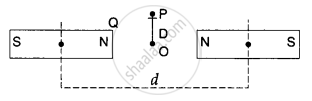
Two identical bar magnets are fixed with their centres at a distance d apart. A stationary charge Q is placed at P in between the gap of the two magnets at a distance D from the centre O as shown in the figure. The force on the charge Q is ______.
According to the Atomic theory, on heating a magnet, the thermal energy of the elementary magnet ______
A paramagnetic sample shows a net magnetisation of 8 Am–1 when placed in an external magnetic field of 0.6 T at a temperature of 4 K. When the same sample is placed in an external magnetic field of 0.2 T at a temperature of 16 K, the magnetisation will be ______.
Essential difference between electrostatic shielding by a conducting shell and magnetostatic shielding is due to ______.
- electrostatic field lines can end on charges and conductors have free charges.
- lines of B can also end but conductors cannot end them.
- lines of B cannot end on any material and perfect shielding is not possible.
- shells of high permeability materials can be used to divert lines of B from the interior region.
Which of the following has a permeability less than that of free space?
What is magnetic hysterisis?
Explain the meaning of the following statement:
Curie temperature for soft iron is 770°C.
