Please select a subject first
Advertisements
Advertisements
At the break-even point level of incomes for the economy is ₹ 10,000 crores and if the people tends to save 20 per cent of their additional income, then calcualte the value of autonomous consumption.
Concept: Aggregate Demand and Its Components >> Consumption
Read the following statements carefully:
Statement 1: Consumption function assumes that, consumption changes at a constant rate as income changes.
Statement 2: Autonomous consumption is the ratio of total consumption (C) to total income (Y).
In light of the given statements, choose the correct alternative from the following:
Concept: Aggregate Demand and Its Components >> Consumption
Graphically, Aggregate Demand function can be obtained by vertically adding the ______ and ______ function.
Concept: Determination of Equilibrium Income in the Short Run >> Macroeconomic Equilibrium with Price Level Fixed
Suppose for a given economy,
S = -60 + 0.1Y
I = ₹ 4,000 crore
(Where S = Saving Function, Y = National Income and I = Investment Expenditure)
Equilibrium level of Income would be ₹ ______ crore.
Concept: Determination of Equilibrium Income in the Short Run >> Effect of an Autonomous Change in Aggregate Demand on Income and Output
“Ravya was initially working as an office clerk in a firm. In the pursuit to attain, a higher position and income, she attended a few on-the-job training sessions. These sessions contributed positively to her skills and expertise.”
Explain the impact of Ravya’s decision on human capital formation.
Concept: Sources of Human Capital
What is capital expenditure?
Concept: Classification of Expenditure
Give the equation of Budget Line.
Concept: Types of Budget
Explain the role of the government budget infighting inflationary and deflationary tendencies.
Concept: Objectives of Government Budget
Calculate investment expenditure from the following date about an economy which is in equilibrium :
National Income = 1000
Marginal propensity to save = 0.20
Autonomous consumption expenditure = 100
Concept: Classification of Expenditure
Calculate Autonomous Consumption Expenditure from the following data about an economy which is in equilibrium:
National income = 500
Marginal propensity to save = 0.30
Investment expenditure = 100
Concept: Classification of Expenditure
What is the difference between revenue expenditure and capital expenditure? Explain how taxes and government expenditure can be used to influence.
Concept: Classification of Expenditure
Discuss the importance of credit in rural development.
Concept: Credit and Marketing in Rural Areas
Critically evaluate the role of the rural banking system in the process of rural development in India.
Concept: Credit and Marketing in Rural Areas
Enlist some problems faced by farmers during the initial years of organic farming.
Concept: Sustainable Development and Organic Farming
Answer the following question.
How are capital expenditure different from Revenue expenditure? Discuss briefly.
Concept: Classification of Expenditure
Define "Trade surplus" and "Trade Deficit".
Concept: Types of Budget
Compare the trends depicted in the figures given below:
| Figure 1: Trends in Fiscal deficit and Primary deficit |
Figure 2: Fiscal deficit as a percent of Budget estimate |
 |
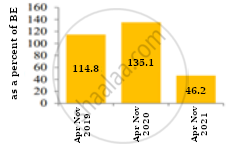 |
Concept: Measures of Government Deficit
Identify which of the following is a source of non-institutional credit in the rural areas of India.
Concept: Credit and Marketing in Rural Areas
Define agricultural marketing.
Concept: Agricultural Market System
Discuss briefly the importance of micro-credit programmes in rural development.
Concept: Credit and Marketing in Rural Areas
