Advertisements
Advertisements
Question
Obtain the expression for energy stored in the parallel plate capacitor.
Advertisements
Solution
- Capacitor not only stores the charge but also stores energy.
- When a battery is connected to the capacitor, electrons of total charge -Q are transferred from one plate to the other plate.
- To transfer the charge, work is done by the battery. This work done is stored as electrostatic potential energy in the capacitor.
- To transfer an infinitesimal charge dQ for a potential difference V, the work done is given by
dW = V dQ ………….(1)
where V = `"Q"/"C"`
The total work done to charge a capacitor is
W = `int_0^"Q" "Q"/"C" "dQ" = "Q"^2/"2C"` .....(2)
This work done is stored as electrostatic potential energy (UB) in the capacitor.
`"U"_"E" = "Q"^2/"2C" = 1/2 "CV"^2` ....(3)
where Q = CV is used. - This stored energy is thus directly proportional to the capacitance of the capacitor and the square of the voltage between the plates of the capacitor.
`"U"_"E" = 1/2 ((ε_0"A")/"d")("Ed")^2 = 1/2 ε_0 ("Ad")"E"^2` ....(4)
where Ad = volume of the space between the capacitor plates. The energy stored per unit volume of space is defined `"U"_"E" = 1/2ε_0 "E"^2` .....(5) - Energy is stored in the electric field existing between the plates of the capacitor. 0nce the capacitor is allowed to discharge, the energy is retrieved.
- The energy density depends only on the electric field and not on the size of the plates of the capacitor.
APPEARS IN
RELATED QUESTIONS
A spherical capacitor has an inner sphere of radius 12 cm and an outer sphere of radius 13 cm. The outer sphere is earthed and the inner sphere is given a charge of 2.5 µC. The space between the concentric spheres is filled with a liquid of dielectric constant 32.
(a) Determine the capacitance of the capacitor.
(b) What is the potential of the inner sphere?
(c) Compare the capacitance of this capacitor with that of an isolated sphere of radius 12 cm. Explain why the latter is much smaller.
As `C = (1/V) Q` , can you say that the capacitance C is proportional to the charge Q?
Three capacitors of capacitances 6 µF each are available. The minimum and maximum capacitances, which may be obtained are
A cylindrical capacitor is constructed using two coaxial cylinders of the same length 10 cm and of radii 2 mm and 4 mm. (a) Calculate the capacitance. (b) Another capacitor of the same length is constructed with cylinders of radii 4 mm and 8 mm. Calculate the capacitance.
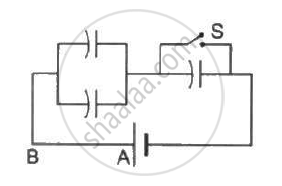
Each capacitor shown in figure has a capacitance of 5⋅0 µF. The emf of the battery is 50 V. How much charge will flow through AB if the switch S is closed?
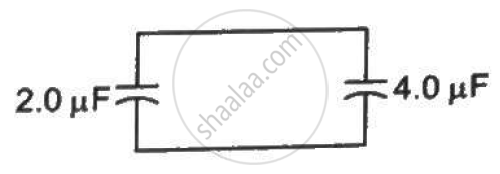
A capacitor of capacitance 2⋅0 µF is charged to a potential difference of 12 V. It is then connected to an uncharged capacitor of capacitance 4⋅0 µF as shown in figure . Find (a) the charge on each of the two capacitors after the connection, (b) the electrostatic energy stored in each of the two capacitors and (c) the heat produced during the charge transfer from one capacitor to the other.
A 5⋅0 µF capacitor is charged to 12 V. The positive plate of this capacitor is now connected to the negative terminal of a 12 V battery and vice versa. Calculate the heat developed in the connecting wires.
Suppose the space between the two inner shells is filled with a dielectric of dielectric constant K. Find the capacitance of the system between A and B.
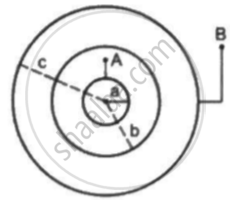
Figure shows two parallel plate capacitors with fixed plates and connected to two batteries. The separation between the plates is the same for the two capacitors. The plates are rectangular in shape with width b and lengths l1 and l2. The left half of the dielectric slab has a dielectric constant K1 and the right half K2. Neglecting any friction, find the ration of the emf of the left battery to that of the right battery for which the dielectric slab may remain in equilibrium.
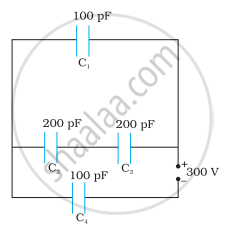
Obtain the equivalent capacitance of the network shown in the figure. For a 300 V supply, determine the charge on each capacitor.