Advertisements
Advertisements
Question
The susceptibility of magnesium at 200 K is 1.8 x 10⁻⁵. At what temperature will the susceptibility decrease by 6 x 10⁻⁶?
Advertisements
Solution
Given,
T = 200K,
χ1 = 1.8 × 10⁻⁵
χ1 - χ2 = 6 × 10⁻⁶
To Find: Required temperature (T2)
Formula: χT=constatnt
Calculation :
χ1 - χ2 = 6 × 10⁻⁶
χ2 = 1.8×10⁻⁵ - 0.6×10⁻⁵
χ2 = 1.2 ×10⁻⁵
From formula,
∴χT = constant
χ1T1 = χ2T2
`T_2 =(chi_1T_1)/chi_2`
`T_2=(1.8xx10^-5xx200)/(1.2xx10^-5)`
`T_2 = 300K `
The required temperature is 300 K.
APPEARS IN
RELATED QUESTIONS
Distinguish between ‘paramagnetic’ and ‘ferromagnetic’ substances.
Which of the following substances is ductile?
Give any ‘two’ points of differences between diamagnetic and ferromagnetic substances.
An iron rod of the area of cross-section 0.1m2 is subjected to a magnetizing field of 1000 A/m. Calculate the magnetic permeability of the iron rod. [Magnetic susceptibility of iron = 59.9, magnetic permeability of vacuum = 4π x 10-7 S. I. unit]
Show diagrammatically the behaviour of magnetic field lines in the presence of (i) paramagnetic and (ii) diamagnetic substances. How does one explain this distinguishing feature?
A meter gauge train is heading north with speed 54 km/hr in earth's magnetic field 3 x 10⁻⁴T. The e.m.f. induced across the axle joining the wheels is ..........
(a) 0.45 mV
(b) 4.5 mV
(c) 45 mV
(d) 450 m V
The magnetic susceptibility of annealed iron at saturation is 4224. Find the permeability of
annealed iron at saturation. (μ0 = 4Π × 10−7 SI unit)
Explain Curie’s law for a paramagnetic substance.
Which of the following substances are diamagnetic?
Bi, Al, Na, Cu, Ca and Ni
Which of the following substances are para-magnetic?
Bi, Al, Cu, Ca, Pb, Ni
The relative magnetic permeability of a magnetic material is 800. Identify the nature of magnetic material and state its two properties.
Two substances A and B have their relative permeability slightly greater and slightly less than 1 respectively. What do you conclude about A and B as far as their magnetic materials are concerned?
Choose the correct option:
A rectangular magnet suspended freely has a period of oscillation equal to T. Now it is broken into two equal halves (each having half of the original length) and one piece is made to oscillate freely. Its period of oscillation is T′, the ratio of T′/T is ______.
The susceptibility of a magnetic material is positive and small. The material is ______.
The magnetic susceptibility of a paramagnetic material at - 73 °C is 0.0075. Its value at -173 °C will be ______.
If a magnetic field is applied to a liquid in one arm of a narrow U-tube, the liquid level in that arm is lowered. The liquid in U-tube arm is ______.
Relative permittivity and permeability of a material are `epsilon_"r"` and `µ_"r"` respectively. Which of the following values of these quantities are allowed for a diamagnetic material?
There are three needles 'N1', 'N2' and 'N3' made of a ferromagnetic, a paramagnetic and a diamagnetic substance respectively. When a magnet is brought close to them, then it will ____________.
The magnetic property of magnetic substance is associated with ____________.
Above the curie temperature the susceptibility of ferromagnetic substance varies ____________.
A small quantity of paramagnetic liquid is taken in a watch - glass and kept on two dissimilar magnetic poles. The liquid ____________.
A domain in a ferromagnetic substance is in the form of a cube of side length 1 µm. If it contains 6 x 10¹⁰ atoms and each atomic dipole has a dipole moment of 7 x 10-24 Am2, then magnetization of the domain is ____________.
A short bar magnet has a magnetic moment of 0.48 J T−1. Give the direction and magnitude of the magnetic field produced by the magnet at a distance of 10 cm from the centre of the magnet on
- the axis,
- the equatorial lines (normal bisector) of the magnet.
Why does a paramagnetic sample display greater magnetisation (for the same magnetising field) when cooled?
If a toroid uses bismuth for its core, will the field in the core be (slightly) greater or (slightly) less than when the core is empty?
Explain qualitatively on the basis of domain picture the irreversibility in the magnetisation curve of a ferromagnet.
A certain region of space is to be shielded from magnetic fields. Suggest a method.
Assertion: The ferromagnetic substance do not obey Curie’s law.
Reason: At Curie point a ferromagnetic substance start behaving as a paramagnetic substance.
The magnetic susceptibility is negative for ______.
Which of the following property shows the property of ferromagnetic substances?
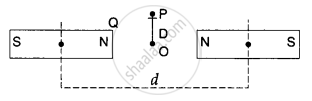
Two identical bar magnets are fixed with their centres at a distance d apart. A stationary charge Q is placed at P in between the gap of the two magnets at a distance D from the centre O as shown in the figure. The force on the charge Q is ______.
Most of the substance show which of the magnetic property:-
Explain quantitatively the order of magnitude difference between the diamagnetic susceptibility of N2 (~5 × 10⁻⁹) (at STP) and Cu (~10–5).
From molecular view point, discuss the temperature dependence of susceptibility for diamagnetism, paramagnetism and ferromagnetism.
If the magnetizing field on a ferromagnetic material is increased, its permeability ______.
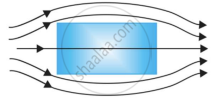
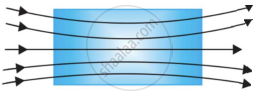
A uniform magnetic field gets modified as shown in figure when two specimens A and B are placed in it.
 |
 |
| (a) | (b) |
- Identify the specimen A and B.
- How is the magnetic susceptibility of specimen A different from that of specimen B?
- Assertion (A): Diamagnetic substances exhibit magnetism.
- Reason (R): Diamagnetic materials do not have a permanent magnetic dipole moment.
Which of the following cannot modify an external magnetic field as shown in the figure?

The relative magnetic permeability of a substance X is slightly less than unity and that of substance Y is slightly more than unity, then ______.
What is magnetic hysterisis?
Explain ferromagnetism on the basis of the domain theory.
Magnetic susceptibility of a diamagnetic substance ______.
