Advertisements
Advertisements
Question
The susceptibility of a paramagnetic material is χ at 27° C. At what temperature its susceptibility be χ/3?
Advertisements
Solution
Data: χm1 = χ, T1 = 27°C = 300 K, χm2 = `χ/3`
By Curie's law,
`"M"_"z" = "C" "B"_0/"T"`
Since Mz = χmH and B0 = μ0H
χmH = C`(mu_0"H")/"T"`
∴ χm = C `mu_0/"T"`
∴ χm ∝ `1/"T"`
∴ `(chi_"m1")/(chi_"m2") = "T"_2/"T"_1`
∴ `"T"_2 = (chi_"m1")/(chi_"m2") xx "T"_1 = 3 chi/chi xx 300 = 900 "K" = 627^circ "C"`
APPEARS IN
RELATED QUESTIONS
Which of the following substances is ductile?
The susceptibility of magnesium at 200 K is 1.8 x 10⁻⁵. At what temperature will the susceptibility decrease by 6 x 10⁻⁶?
Out of the two magnetic materials, 'A' has relative permeability slightly greater than unity while 'B' has less than unity. Identify the nature of the materials 'A' and 'B'. Will their susceptibilities be positive or negative?
The magnetic susceptibility of annealed iron at saturation is 4224. Find the permeability of
annealed iron at saturation. (μ0 = 4Π × 10−7 SI unit)
Explain Curie’s law for a paramagnetic substance.
Which of the following substances are para-magnetic?
Bi, Al, Cu, Ca, Pb, Ni
The susceptibility of a magnetic material is − 2.6 × 10⁻⁵. Identify the type of magnetic material and state its two properties.
The relative magnetic permeability of a magnetic material is 800. Identify the nature of magnetic material and state its two properties.
Draw magnetic field line when a (i) diamagnetic, (ii) paramagnetic substance is placed in an external magnetic field. Which magnetic property distinguishes this behaviour of the field line due to the substances?
A tangent galvanometer shows a deflection of 45° when 10 mA of current is passed through it. If the horizontal component of the earth's magnetic field is `B_H = 3.6 xx 10^-5 "T"` and radius of the coil is 10 cm, find the number of turns in the coil.
Answer the following question.
Write three points of differences between para-, dia- and ferromagnetic materials, giving one example for each.
Which of the following statements is correct for diamagnetic materials?
What happens to a ferromagnetic material when its temperature increases above curie temperature?
Answer in brief.
Discuss the Curie law for paramagnetic material.
A rod of magnetic material of cross-section 0.25 cm2 is placed in a magnetizing field of intensity 4000 A/m-1. The magnetic flux passing through the rod is 25 × 10-6 Wb. Find out
(a) relative permeability
(b) magnetic susceptibility and
(c) magnetisation of the rod.
For a paramagnetic substance, the magnetic susceptibility is ______.
The susceptibility of a magnetic material is positive and small. The material is ______.
The magnetic susceptibility of a paramagnetic material at - 73 °C is 0.0075. Its value at -173 °C will be ______.
Magnetic material can be easily magnetized if magnetic susceptibility is ______.
Relative permittivity and permeability of a material are `epsilon_"r"` and `µ_"r"` respectively. Which of the following values of these quantities are allowed for a diamagnetic material?
There are three needles 'N1', 'N2' and 'N3' made of a ferromagnetic, a paramagnetic and a diamagnetic substance respectively. When a magnet is brought close to them, then it will ____________.
The magnetic property of magnetic substance is associated with ____________.
The product of magnetic susceptibility (`chi`) and absolute temperature (T) is constant for a ____________.
A domain in a ferromagnetic substance is in the form of a cube of side length 1 µm. If it contains 6 x 10¹⁰ atoms and each atomic dipole has a dipole moment of 7 x 10-24 Am2, then magnetization of the domain is ____________.
The earth’s field departs from its dipole shape substantially at large distances (greater than about 30,000 km). What agencies may be responsible for this distortion?
A short bar magnet has a magnetic moment of 0.48 J T−1. Give the direction and magnitude of the magnetic field produced by the magnet at a distance of 10 cm from the centre of the magnet on
- the axis,
- the equatorial lines (normal bisector) of the magnet.
Magnetic field lines are always nearly normal to the surface of a ferromagnet at every point. (This fact is analogous to the static electric field lines being normal to the surface of a conductor at every point.) Why?
Would the maximum possible magnetisation of a paramagnetic sample be of the same order of magnitude as the magnetisation of a ferromagnet?
Explain qualitatively on the basis of domain picture the irreversibility in the magnetisation curve of a ferromagnet.
What kind of ferromagnetic material is used for coating magnetic tapes in a cassette player, or for building ‘memory stores’ in a modern computer?
A Rowland ring of mean radius 15 cm has 3500 turns of wire wound on a ferromagnetic core of relative permeability 800. What is the magnetic field B in the core for a magnetising current of 1.2 A?
Nickel shows ferromagnetic property at room temperature. If the temperature is increased beyond curie temperature, then it will show ______.
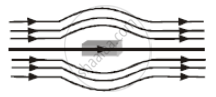
The given figure represents a material which is ______.
Assertion: A paramagnetic sample display greater magnetisation (for the same magnetic field) when cooled.
Reason: The magnetisation does not depend on temperature.
Which of the following property shows the property of ferromagnetic substances?
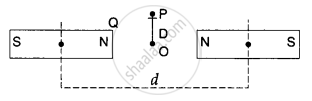
Two identical bar magnets are fixed with their centres at a distance d apart. A stationary charge Q is placed at P in between the gap of the two magnets at a distance D from the centre O as shown in the figure. The force on the charge Q is ______.
When a ferromagnetic material is created above its curie temperature
A paramagnetic sample shows a net magnetisation of 8 Am–1 when placed in an external magnetic field of 0.6 T at a temperature of 4 K. When the same sample is placed in an external magnetic field of 0.2 T at a temperature of 16 K, the magnetisation will be ______.
A permanent magnet in the shape of a thin cylinder of length 10 cm has M = 106 A/m. Calculate the magnetisation current IM.
From molecular view point, discuss the temperature dependence of susceptibility for diamagnetism, paramagnetism and ferromagnetism.
If the magnetizing field on a ferromagnetic material is increased, its permeability ______.
Magnetic susceptibility for a paramagnetic and diamagnetic materials is respectively ______.
An ammeter of resistance R gives a full-scale deflection when a current of 2 A passes through it. If it is measured with a maximum current of 10 A, the required shunt is ______.
- Assertion (A): Diamagnetic substances exhibit magnetism.
- Reason (R): Diamagnetic materials do not have a permanent magnetic dipole moment.
What is magnetic hysterisis?
Explain ferromagnetism on the basis of the domain theory.
Explain the origin of paramagnetism on the basis of atomic structure.
State the dimensions of magnetization.
Explain the Domain theory in brief.
