Advertisements
Advertisements
Question
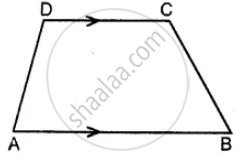
The following figure shows a quadrilateral in which sides AB and DC are parallel. If ∠A : ∠D = 4 : 5, ∠B = (3x – 15)° and ∠C = (4x + 20)°, find each angle of the quadrilateral ABCD.
Advertisements
Solution
Let ∠A = 4x
∠D = 5x
Since ∠A + ∠D = 180° [AB||DC]
4x + 5x = 180°
⇒ 9x = 180°
⇒ x = 20°
∠A = 4 (20) = 80°,
∠D = 5 (20) = 100°
Again ∠B + ∠C = 180° [ AB||DC]
3x – 15° + 4x + 20° = 180°
7x = 180° – 5°
⇒ 7x = 175°
⇒ x = 25°
∠B = 75° – 15° = 60°
and ∠C = 4 (25) + 20 = 100°+ 20°= 120°
RELATED QUESTIONS
Complete of the following, so as to make a true statement:
In a quadrilateral the point of intersection of the diagonals lies in .... of the quadrilateral.
Complete of the following, so as to make a true statement:
A quadrilateral is convex if, for each side, the remaining ______ lie on the same side of the line containing the side.
In Fig. 16.19, ABCD is a quadrilateral.
How many pairs of opposite sides are there?
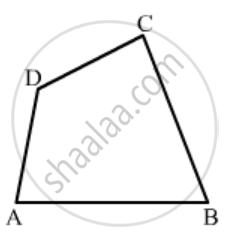
If the bisectors of two adjacent angles A and B of a quadrilateral ABCD intersect at a point O such that ∠C + ∠D = k ∠AOB, then find the value of k.
ABCD is a trapezium in which AB || DC. M and N are the mid-points of AD and the respectively. If AB = 12 cm, MN = 14 cm, then CD =
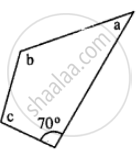
In the given figure : ∠b = 2a + 15 and ∠c = 3a + 5; find the values of b and c.
In a trapezium ABCD, side AB is parallel to side DC. If ∠A = x° and ∠D = (3x – 20)°; find the value of x.
In parallelogram ABCD, ∠A = 90°
(i) What is the measure of angle B.
(ii) Write the special name of the parallelogram.
Write, giving reason, the name of the figure drawn alongside. Under what condition will this figure be a square.
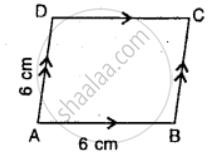
Observe the figure below and find out their name.

One angle of a pentagon is 160° and the rest are all equal angles. Find the measure of the equal angles.
ΔPQR and ΔSQR are on the same base QR with P and S on opposite sides of line QR, such that area of ΔPQR is equal to the area of ΔSQR. Show that QR bisects PS.
If angles A, B, C and D of the quadrilateral ABCD, taken in order, are in the ratio 3 : 7 : 6 : 4, then ABCD is a ______.
If bisectors of ∠A and ∠B of a quadrilateral ABCD intersect each other at P, of ∠B and ∠C at Q, of ∠C and ∠D at R and of ∠D and ∠A at S, then PQRS is a ______.
In quadrilateral WXYZ, the pairs of opposite angles are ______.
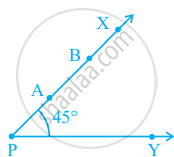
In the following figure, if point A is shifted to point B along the ray PX such that PB = 2PA, then the measure of ∠BPY is ______.
A pair of opposite sides of a trapezium are ______.
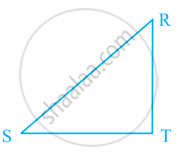
Using the information given, name the right angles in part of figure:
RT ⊥ ST
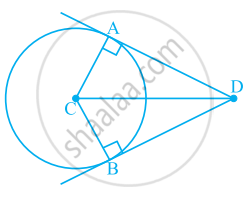
What conclusion can be drawn from part of given figure, if DC is the bisector of ∠ADB, CA ⊥ DA and CB ⊥ DB?
How many points are required to form a quadrilateral?
