Advertisements
Advertisements
Question
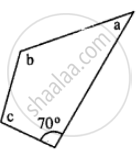
In the given figure : ∠b = 2a + 15 and ∠c = 3a + 5; find the values of b and c.
Advertisements
Solution
∵ Sum of angles of quadrilateral = 360°
70° + a + 2a + 15 + 3a + 5 = 360°
6a + 90° = 360°
6a = 270°
a = 45°
∴ b = 2a + 15 = 2 x 45 + 15 = 105°
c = 3a + 5 = 3 x 45 + 5 = 140°
Hence ∠b and ∠c are 105° and 140°
APPEARS IN
RELATED QUESTIONS
How many diagonals does following have?
A convex quadrilateral
The perimeter of a parallelogram is 22 cm . If the longer side measures 6.5 cm what is the measure of the shorter side?
In a quadrilateral, define of the following Sides.
Complete of the following, so as to make a true statement:
The sum of the angles of a quadrilateral is ......
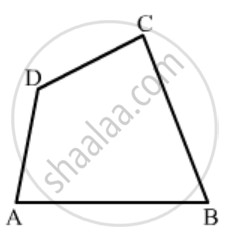
In Fig. 16.19, ABCD is a quadrilateral.
Name a pair of adjacent sides.
A quadrilateral has three acute angles each measures 80°. What is the measure of the fourth angle?
If the sum of the two angles of a quadrilateral is 180°. What is the sum of the remaining two angles?
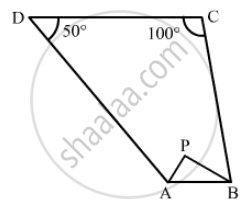
In Fig. 16.21, the bisectors of ∠A and ∠B meet at a point P. If ∠C = 100° and ∠D = 50°, find the measure of ∠APB.
The measure of angles of a hexagon are x°, (x − 5)°, (x − 5)°, (2x − 5)°, (2x − 5)°, (2x + 20)°. Find the value of x.
Complete the following statement by means of one of those given in brackets against each:
A line drawn from the mid-point of one side of a triangle .............. another side intersects the third side at its mid-point.
From the following figure find;
- x
- ∠ABC
- ∠ACD
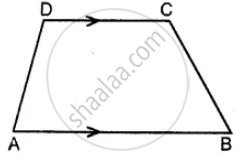
The following figure shows a quadrilateral in which sides AB and DC are parallel. If ∠A : ∠D = 4 : 5, ∠B = (3x – 15)° and ∠C = (4x + 20)°, find each angle of the quadrilateral ABCD.
The diagonals of a rhombus are 6 .cm and 8 cm. State the angle at which these diagonals intersect.
The angles of a hexagon are (2x + 5)°, (3x - 5)°, (x + 40)°, (2x + 20)°, (2x + 25)° and (2x + 35)°. Find the value of x.
In quadrilateral ROPE, the pairs of adjacent angles are ______.
A quadrilateral can be drawn when all the four angles and one side is given.
In the following figure, What is AC – EC?
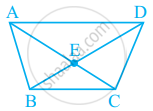
Using the information given, name the right angles in part of figure:
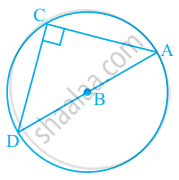
AC ⊥ CD
Draw a rough sketch of a quadrilateral PQRS. Draw its diagonals. Name them. Is the meeting point of the diagonals in the interior or exterior of the quadrilateral?

Draw a rough sketch of a quadrilateral KLMN. State two pairs of opposite angles.
