Advertisements
Advertisements
प्रश्न
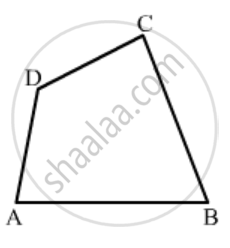
Given : In quadrilateral ABCD ; ∠C = 64°, ∠D = ∠C – 8° ; ∠A = 5(a+2)° and ∠B = 2(2a+7)°.
Calculate ∠A.
Advertisements
उत्तर
∵ ∠C = 64° (Given)
∴ ∠D = ∠C – 8° = 64°- 8° = 56°
∠A = 5(a+2)°
∠B = 2(2a+7)°
Now ∠A + ∠B + ∠C + ∠D = 360°
5(a+2)° + 2(2a+7)° + 64° + 56° = 360°
5a + 10 + 4a + 14° + 64° + 56° = 360°
9a + 144° = 360°
9a = 360° – 144°
9a = 216°
a = 24°
∴ ∠A = 5 (a + 2) = 5(24+2) = 130°
संबंधित प्रश्न
How many diagonals does following have?
A convex quadrilateral
In a quadrilateral, define of the following Sides.
In a quadrilateral, define of the following Vertices .
In a quadrilateral, define of the following Adjacent angles .
In Fig. 16.19, ABCD is a quadrilateral.
How many pairs of adjacent sides are there?
If the sum of the two angles of a quadrilateral is 180°. What is the sum of the remaining two angles?
In a quadrilateral ABCD, CO and DO are the bisectors of ∠C and ∠D respectively. Prove that \[∠COD = \frac{1}{2}(∠A + ∠B) .\]
Determine the number of sides of a polygon whose exterior and interior angles are in the ratio 1 : 5.
Complete the following statement by means of one of those given in brackets against each:
If one pair of opposite sides are equal and parallel, then the figure is ........................
Complete the following statement by means of one of those given in brackets against each:
A line drawn from the mid-point of one side of a triangle .............. another side intersects the third side at its mid-point.
Three angles of a quadrilateral are equal. If the fourth angle is 69°; find the measure of equal angles.
Find the angles of a pentagon which are in the ratio 4: 4: 6: 7: 6.
ΔPQR and ΔSQR are on the same base QR with P and S on opposite sides of line QR, such that area of ΔPQR is equal to the area of ΔSQR. Show that QR bisects PS.
The angles of a quadrilateral are in the ratio 2 : 4 : 5 : 7. Find all the angles
ABCD is a quadrilateral in which AB || DC and AD = BC. Prove that ∠A = ∠B and ∠C = ∠D.
If the sum of two angles is greater than 180°, then which of the following is not possible for the two angles?
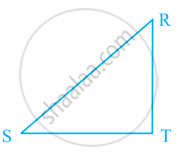
Using the information given, name the right angles in part of figure:
RT ⊥ ST
What conclusion can be drawn from part of given figure, if DB is the bisector of ∠ADC?
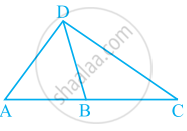
What conclusion can be drawn from part of given figure, if BD bisects ∠ABC?

Investigate :
Use strips and fasteners to make a triangle and a quadrilateral.
Try to push inward at any one vertex of the triangle. Do the same to the quadrilateral. Is the triangle distorted? Is the quadrilateral distorted? Is the triangle rigid?
Why is it that structures like electric towers make use of triangular shapes and not quadrilaterals?