Advertisements
Advertisements
Question
In a quadrilateral ABCD, AO and BO are bisectors of angle A and angle B respectively. Show that:
∠AOB = (∠C + ∠D)
Advertisements
Solution
In a quadrilateral ABCD, AO and BO are the bisectors of ∠A and ∠B, respectively. We need to prove that:
∠AOB = ∠C + ∠D.
The sum of the interior angles of a quadrilateral is: ∠A + ∠B + ∠C + ∠D = 360∘.
Since AO and BO are the bisectors of ∠A\ and ∠B\, we can express: `angleAOB=(angleA)/2+(angleB)/2`
From the sum of the interior angles of the quadrilateral, rearrange to find ∠A+∠B
∠A + ∠B = 360∘ − (∠C + ∠D).
Now substitute ∠A+∠B into the expression for ∠AOB:
`angleAOB= (angleA)/2+(angleB)/2=(angleA+angleB)/2`
Replace ∠A + ∠B with 360∘ − (∠C + ∠D)
`angleAOB=(360°-(angleC+angleD))/2`
Simplify: `angleAOB = 180°-(angleC+angleD)/2`
∠AOB = ∠C + ∠D.
APPEARS IN
RELATED QUESTIONS
What is the sum of the measures of the angels of a convex quadrilateral? Will this property hold if the quadrilateral is not convex? (Make a non-convex quadrilateral and try!)
In a quadrilateral, define of the following Opposite sides .
Complete of the following, so as to make a true statement:
The sum of the angles of a quiadrilateral is .... right angles.
In a quadrilateral ABCD, the angles A, B, C and D are in the ratio 1 : 2 : 4 : 5. Find the measure of each angle of the quadrilateral.
PQRSTU is a regular hexagon. Determine each angle of ΔPQT.
In the given figure, ABCD is a trapezium. Find the values of x and y.

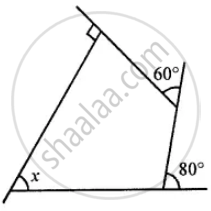
Use the following figure to find the value of x
Observe the figure below and find out their name.

D and E are the mid-points of the sides AB and AC respectively of ∆ABC. DE is produced to F. To prove that CF is equal and parallel to DA, we need an additional information which is ______.
The number of obtuse angles in the following figure is ______.

