Advertisements
Advertisements
Question
Given : In quadrilateral ABCD ; ∠C = 64°, ∠D = ∠C – 8° ; ∠A = 5(a+2)° and ∠B = 2(2a+7)°.
Calculate ∠A.
Advertisements
Solution
∵ ∠C = 64° (Given)
∴ ∠D = ∠C – 8° = 64°- 8° = 56°
∠A = 5(a+2)°
∠B = 2(2a+7)°
Now ∠A + ∠B + ∠C + ∠D = 360°
5(a+2)° + 2(2a+7)° + 64° + 56° = 360°
5a + 10 + 4a + 14° + 64° + 56° = 360°
9a + 144° = 360°
9a = 360° – 144°
9a = 216°
a = 24°
∴ ∠A = 5 (a + 2) = 5(24+2) = 130°
RELATED QUESTIONS
In a quadrilateral, define of the following Sides.
In a quadrilateral, define of the following Interior .
Complete of the following, so as to make a true statement:
The sum of the angles of a quadrilateral is ......
Complete of the following, so as to make a true statement:
The measure of each angle of a convex quadrilateral is ..... 180°.
In Fig. 16.19, ABCD is a quadrilateral.
Name a pair of opposite sides.
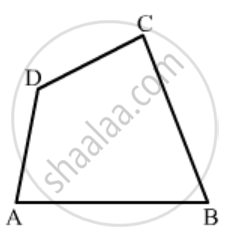
The three angles of a quadrilateral are respectively equal to 110°, 50° and 40°. Find its fourth angle.
PQRSTU is a regular hexagon. Determine each angle of ΔPQT.
Complete the following statement by means of one of those given in brackets against each:
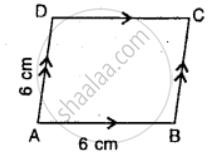
If one pair of opposite sides are equal and parallel, then the figure is ........................
The angles A, B, C and D of a trapezium ABCD are in the ratio 3: 4: 5: 6. Le. ∠A : ∠B : ∠C : ∠D = 3:4: 5 : 6. Find all the angles of the trapezium. Also, name the two sides of this trapezium which are parallel to each other. Give reason for your answer.
Write, giving reason, the name of the figure drawn alongside. Under what condition will this figure be a square.
ΔPQR and ΔSQR are on the same base QR with P and S on opposite sides of line QR, such that area of ΔPQR is equal to the area of ΔSQR. Show that QR bisects PS.
In the quadrilateral ABCD, AB = BC and AD = DC Measure of ∠BCD is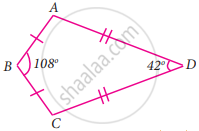
The diagonals of the quadrilateral DEFG are ______ and ______.
A quadrilateral can be drawn when all the four angles and one side is given.
In the following figure,
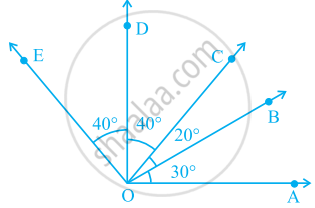
∠AOD is a/an ______ angle
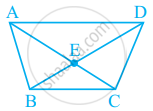
In the following figure, What is AE + EC?
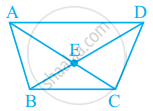
In the following figure, What is BD – BE?
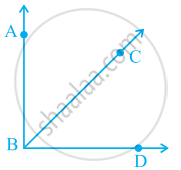
Using the information given, name the right angles in part of figure:
BA ⊥ BD
Can we have two obtuse angles whose sum is a reflex angle? Why or why not?
Draw a rough sketch of a quadrilateral KLMN. State two pairs of adjacent sides.
